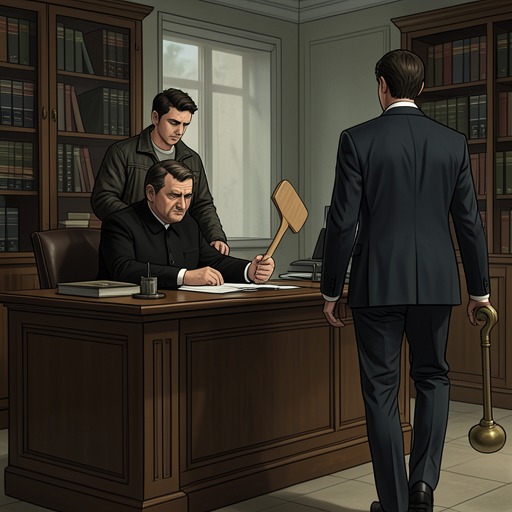
Sammy Mendoza
Dead ShotSammy Mendoza is a 26-year-old society reporter at The Register and Kelly Mendoza’s cousin. His place in the newsroom is defined less by investigative ability than by nepotism, gossip, and access: he occupies a position created through family connection, appears largely detached from serious reporting, and nevertheless becomes a small but consequential link in the story’s information network. His most important action is quietly entering Guy Thompson’s office and reading Cal Murphy’s latest text, an intrusion that gathers the newspaper’s mounting problems around the people closest to them.
Identity and Position
Sammy works at the workstation behind Cal Murphy’s desk, beside Kelly Mendoza’s photo department. He is assigned to cover society functions, but the assignment does not suggest a conventional reporter’s ambition. His routine is dominated by social information—who is having an affair and who has bought an expensive luxury automobile—rather than by the deaths, drug evidence, or institutional pressure consuming Cal and Kelly’s investigation.
The newsroom description makes Sammy’s family relationship explicit: he is Kelly Mendoza’s cousin, and his position is associated with nepotism. At twenty-six, he belongs to a younger and less established layer of The Register’s staff than long-serving employees such as Edith Caraway and Earl Munroe. Yet his proximity to the photo department and to the paper’s leadership gives him practical access to conversations, devices, and information that exceed the apparent importance of his beat.
The Newsroom and Its Information Hierarchy
Sammy’s role is part of the broader contrast between The Register’s ordinary production routines and the dangerous story Cal Murphy and Kelly Mendoza are pursuing. Guy Thompson orders Cal to go to the sheriff’s office, seek information from Sheriff Jones, and keep Kelly with him to obtain a dominant photograph for the Wednesday paper. This command places journalism inside a system of deadlines, visual presentation, and official access, while Sammy remains attached to the lighter social side of the paper.
The contrast sharpens when Guy Thompson threatens to reduce Cal’s work to a reaction piece. Guy’s instruction strips the investigation of its hoped-for significance and turns reporting into a routine transcription of other people’s responses. Sammy’s gossip-oriented beat belongs to the same newsroom economy, but in a different register: both forms of coverage organize public attention, one through scandal and social detail, the other through the controlled handling of a potentially explosive story.
Sammy also exists within a newsroom where information is repeatedly restricted or redirected. Cal is warned to remain silent about the attack and the truth surrounding it, while Guy fears that Cal’s pursuit could end in his death. Against this background, Sammy’s access to internal communications is not merely comic or incidental. The paper’s employees are themselves part of the circulation system through which secrets are protected, exposed, and redistributed.
The Office Intrusion
After most of the staff have become absorbed in their work and the remaining marketing, sales, and circulation personnel have left, Sammy decides that no one will notice him entering Guy Thompson’s office. He is correct. The timing matters: the office is temporarily unguarded, and Guy’s desk or phone becomes an accessible archive of the paper’s private communications.
Sammy checks Guy’s recent call list and finds nothing. He then opens the text-message list and reads Cal Murphy’s most recent message at the top. The action is quiet and methodical rather than openly confrontational. Sammy does not announce what he has found, challenge Guy, or warn Cal; he closes the phone and goes to the break room.
The scene gives Sammy a form of agency that his society assignment otherwise obscures. He is not pursuing the main investigation in the manner of Cal Murphy and Kelly Mendoza, but he recognizes that Guy’s phone may contain information worth taking. His choice to inspect the calls first and then the texts suggests curiosity or concern without establishing a fully stated motive. The evidence supports the act and its significance, not a broader explanation of his intentions.
Connection to the Wider Conspiracy
Sammy’s intrusion occurs while the larger case is being shaped by competing claims about what the town should know. Cal is told that the deaths of the three boys should be treated as a matter of funeral arrangements and flowers, while he continues to suspect that something strange is being concealed. Guy’s pressure on Cal, the warning letter demanding silence, and the threat surrounding the investigation all place private communications under unusual weight.
The warning sent to Cal Murphy describes the attackers as viewing him as an important ally while ordering him to keep the previous night’s events secret and create a cover story. It also explicitly tells him not to show the letter or disclose its contents to Kelly Mendoza or Guy Thompson. Sammy’s later reading of Cal’s text therefore takes place within a chain of secrecy that already includes threats, newsroom control, law-enforcement pressure, and hidden government involvement.
Sammy is not shown as the author of that pressure, nor is he identified as a principal conspirator. His importance is narrower and more precise. By entering Guy’s office, he crosses the boundary between ordinary newsroom labor and the protected communications surrounding the investigation. The narrator notes that Mr. Gold would not be happy, but that at least all his problems were gathering in one place. Sammy’s act thus helps concentrate the story’s separate pressures—Guy’s authority, Cal’s message, and the interests of Nathan Gold—within a single private space.
Narrative Function and Limits
Sammy functions as a threshold character between the paper’s public face and its concealed dealings. He is close enough to the central actors to gain access, but peripheral enough that the main investigation is not his stated concern. His society-reporting identity foregrounds gossip, while his office intrusion turns him into a participant in the story’s deeper information politics.
His characterization remains limited rather than fully developed. The supplied scenes establish his age, family connection, assignment, habits of conversation, and covert inspection of Guy’s phone, but they do not establish a complete ideology, a settled allegiance, or a final resolution for him. That restraint is significant: Sammy is presented less as an independent investigator than as evidence of how easily confidential information can move through an institution whose members occupy overlapping personal and professional relationships.
The eventual publication of Cal Murphy’s story in two newspapers marks a larger movement from restricted knowledge toward public reporting, but the available evidence does not attribute that publication directly to Sammy. His contribution remains the earlier, smaller breach through which private newsroom information becomes vulnerable. In a novel concerned with who controls the story, Sammy demonstrates that the gatekeeping system can be compromised not only by heroic investigation or official exposure, but also by a curious insider with the right access and the wrong reasons for entering an office.